
Monongalia Court Records After Arrest
After a Monongalia County arrest, the jail record and the court record begin to answer different questions. The person may be transported to North Central Regional Jail and Correctional Facility for booking because Monongalia uses the West Virginia regional jail system. The booking side records custody, admission, and facility status. The court side begins when allegations are put into a charging document and filed in the proper court. In West Virginia, the county prosecutor is not called a district attorney. Monongalia County Prosecuting Attorney Gabrielle Mucciola's office handles local prosecution work from the Justice Center at 75 High Street in Morgantown.
Use jail inmate records when the question is whether a person is in custody, where they are housed, or whether they appeared in daily incarcerations. Use jail mugshots for booking-photo limits and request paths. Court records after a jail arrest focus on what the prosecutor filed, what court has the case, what the current charge status is, and whether the charge became a conviction. WVDCR itself warns that sentencing text in custody records is not the official criminal case history, so the court with jurisdiction remains the control point for the case record.
Find Monongalia Court Records After Arrest
The main online starting point is West Virginia Magistrate Case Record Search, commonly called MCRSearch. The judiciary's MCRSearch explanation page says the free system lets users search by first name, last name, or case number and returns up to 30 records. It is useful for finding a Monongalia County magistrate case number and checking whether misdemeanor or preliminary felony matters have appeared after arrest. It does not put the actual court documents online. For copies, call or visit the clerk in the county where the case was filed.
- Search the WV Regional Jail system first if custody is uncertain. Note the full name, admission date, and any public birth-date or agency detail shown.
- Open MCRSearch and search by name. Use the case number instead if it is already known from paperwork or a court notice.
- Review the result list carefully. Similar names can appear, and MCRSearch can return up to 30 records.
- For misdemeanor records or preliminary felony matters, call Monongalia Magistrate Court at (304) 291-7296. For felony circuit records, call the Circuit Clerk at (304) 291-7240.
The MCRSearch form is narrow, which helps explain why names should be checked against jail and court details rather than assumed from one result. Its core fields are:
| Field Label | Type | Required | Notes |
|---|---|---|---|
| First name | Text | Optional search path | Can be used with last name when the full name is known. |
| Last name | Text | Optional search path | Use as much identifying detail as possible because names repeat. |
| Case number | Text | Alternate path | Best when a citation, clerk notice, or attorney gives the exact number. |
| Captcha or continue | Entry step | Required | The portal displays a disclaimer and entry step before searching. |
| Result limit | System limit | Not applicable | The judiciary says the list can generate up to 30 records. |
The judiciary's public instructions for MCRSearch describe the search and copy process. The screenshot below comes from the West Virginia judiciary's magistrate record search explainer.
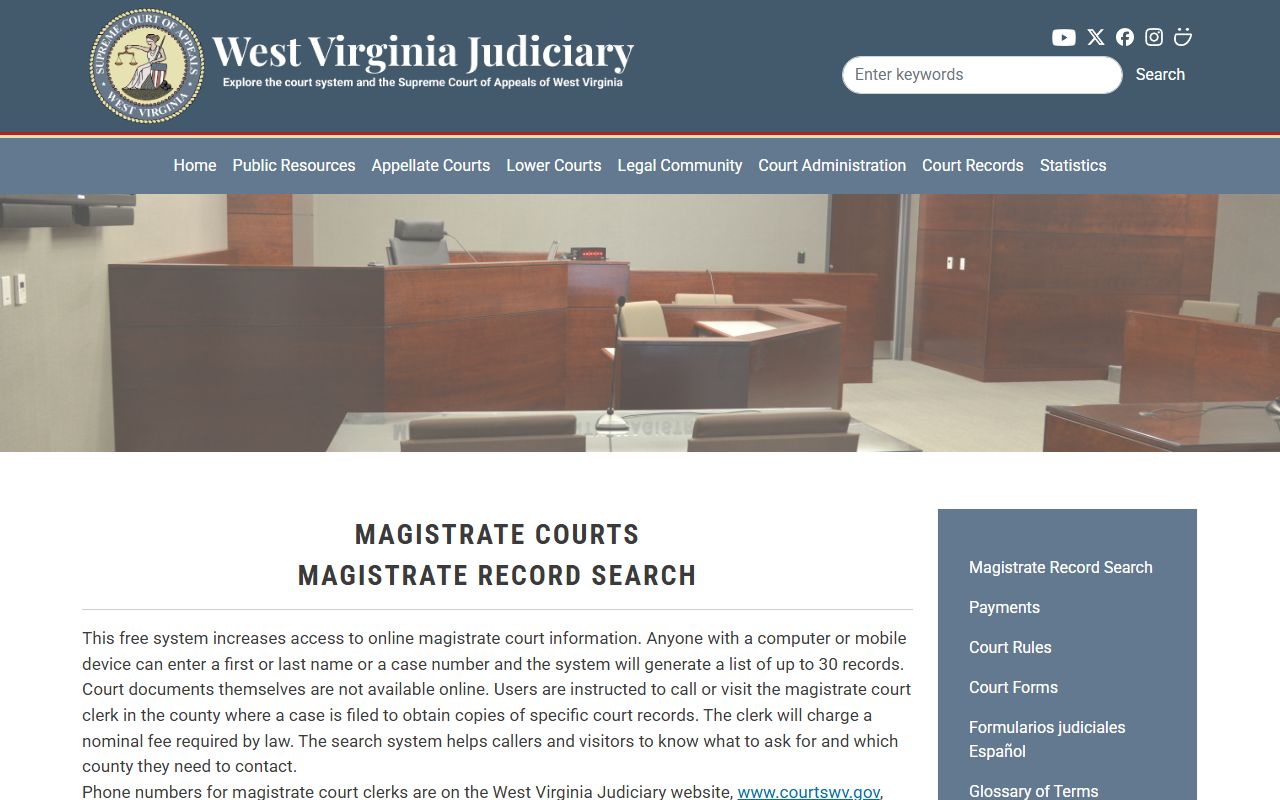
That source is important because it states both sides of the tool: free search access is available, but actual court documents must be requested from the clerk.
Monongalia Arrest Charges in Court
A charge in court is not created by the booking screen alone. Booking happens when the person is processed into jail custody. The court case opens when a complaint, information, indictment, or other charging paper is filed in the proper court. That paper is what turns the arrest allegation into a court record. It may match the arrest wording, but it can also change after prosecutor review, witness input, lab results, or grand-jury action.
| Document | Who Files or Issues It | Where It Commonly Appears | What It Means |
|---|---|---|---|
| Complaint | Officer, complainant, or prosecutor process | Magistrate or initial proceedings | Often the starting charge document after a Monongalia County arrest. |
| Information | Prosecutor | Court where the law permits filing without indictment | A prosecutor-filed charge document, often tied to waiver or a specific procedure. |
| Indictment | Grand jury | Circuit court felony prosecution | A grand-jury accusation that may replace or reshape earlier booking charges. |
The Monongalia County Prosecuting Attorney page is a useful local source for court routing because it lists court-resource contacts, including the Circuit Clerk for felony records and Magistrate Court for misdemeanor records. The prosecutor office page is shown in this screenshot from the Monongalia County Prosecuting Attorney.
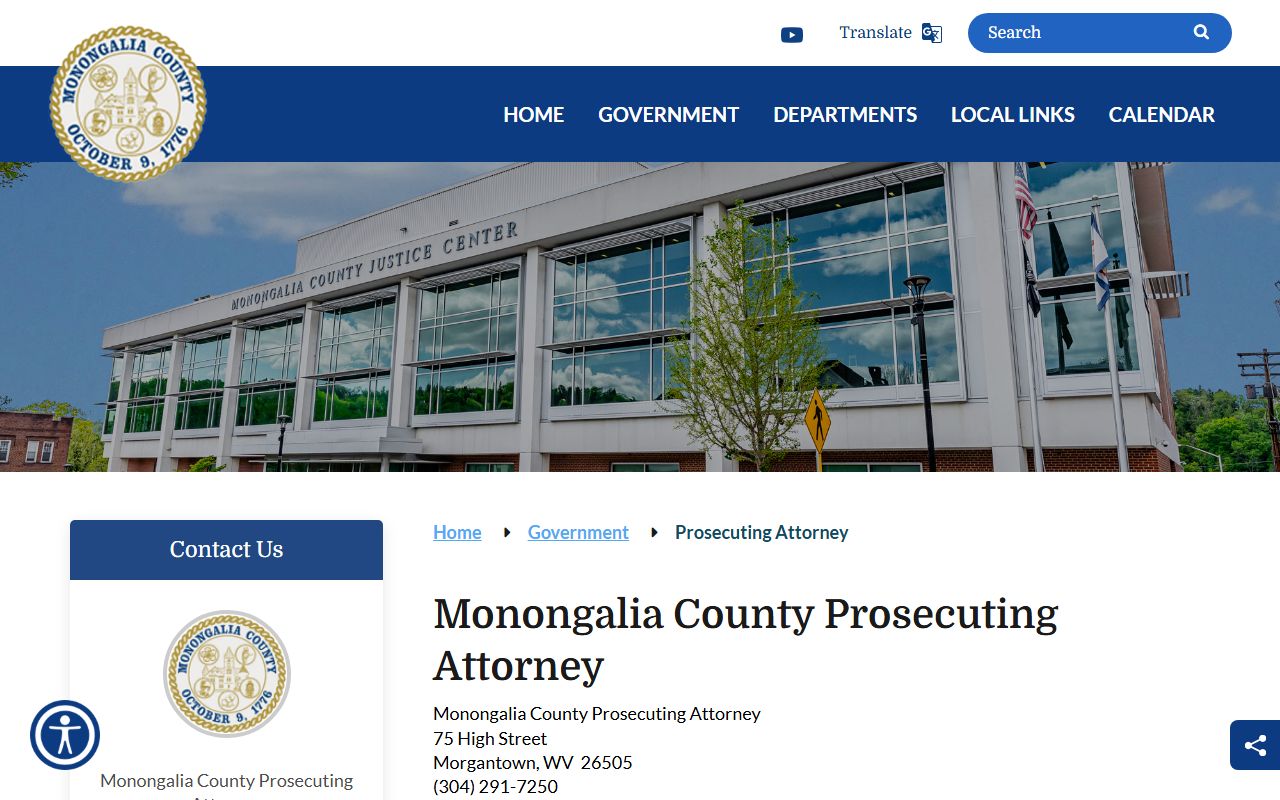
For a record request, that distinction matters. A misdemeanor or preliminary matter may be handled through Magistrate Court, while felony records usually route through the Circuit Clerk once the case is in circuit court.
Monongalia Charge Status Records
Charge status can change more than once after arrest. A booking entry may use the offense known at intake. The court record may later show that the charge is pending, amended, reduced, dismissed, or no longer pursued by the prosecutor. The final status should come from the court file, not from a copied roster entry or an old press release. When a Monongalia County court record after a jail arrest is checked, each count should be reviewed on its own because one charge can be dismissed while another remains active.
| Status | What It Means |
|---|---|
| Pending | The charge is still active and has not reached final disposition. |
| Amended or reduced | The prosecutor or court changed the filed charge, often to a different level or offense. |
| Dismissed | The charge ended without a conviction on that count. |
| Nolle prosequi | The prosecutor declined to continue with the charge. |
| Bound over | A magistrate-level felony matter moved toward circuit court handling. |
| Disposition | The final result of the charge, such as conviction, dismissal, or other court action. |
Bond After Monongalia Arrest
Bond is usually addressed at the first appearance after arrest. It is a court decision, not a jail promise. Monongalia research did not locate a public North Central bond-payment guide with accepted payment methods or cashier hours, so the practical rule is to confirm the active bond type and payment process with the court and the facility before taking money anywhere. North Central can be reached at (304) 873-1384 for facility-specific information, while Magistrate Court handles many initial appearance and misdemeanor bond questions at (304) 291-7296.
| Bond Type | How It Works |
|---|---|
| Cash bond | Money is paid directly as set by the court to secure release and appearance. |
| Surety bond | A licensed bondsman posts the bond, usually with a fee or collateral agreement. |
| Personal recognizance | The court releases the person on a promise to appear, sometimes with conditions. |
| Property bond | Property may be pledged if the court allows that form of bond. |
| No-bond hold | Release is blocked by a court order or agency hold. |
| Detainer or hold | Another county, parole or probation agency, USMS, or ICE issue may keep the person in custody. |
Federal holds are a common source of confusion. North Central's state sources say the facility can house U.S. Marshals detainees by contract. A person with a federal hold may be physically in the regional jail, but local bond may not end federal custody.
Warrants and Monongalia Court Records
A warrant can lead to the arrest that starts the booking and court-record chain. Monongalia County did not have a separate official searchable active-warrant database in the research file. The sheriff's site does publish official news, including Wanted Wednesday posts and daily arrest items, but those posts are not the court docket and should not be treated as a complete warrant list. For warrant checks, use official sheriff posts, MCRSearch, and direct contact with the court or law-enforcement agency.
Useful channels include the Monongalia County Sheriff's Office at (304) 291-7260, MECCA non-emergency 911 at (304) 599-6382 for non-emergency law-enforcement contact, Magistrate Court at (304) 291-7296 for many bench-warrant and misdemeanor matters, and the Circuit Clerk at (304) 291-7240 for felony circuit files. A bench warrant often comes from failure to appear or comply with a court order. An arrest warrant is tied to a criminal accusation. A search warrant authorizes a search of property and is not the same as a jail roster entry.
Charges vs. Monongalia Convictions
An arrest and a charge are not convictions. Court records after a jail arrest can show that the government made an accusation, that a case is pending, or that a charge was changed or dismissed. A conviction requires a guilty plea, verdict, or other finding accepted by the court. That difference matters for employment, housing, licensing, and personal record checks, but this page is not a consumer background-check service.
| Charge | Conviction | |
|---|---|---|
| Stage | Accusation filed after arrest or investigation. | Final court finding or plea of guilt. |
| Proof level | May begin with probable cause or charging review. | Requires proof beyond a reasonable doubt or a valid guilty plea. |
| Record effect | May remain public unless sealed, expunged, or withheld by law. | May carry sentence, fines, supervision, or future record effects. |
| Best source | Complaint, information, indictment, or docket entry. | Disposition, sentencing order, or final judgment. |
Sealed and Expunged Arrest Records
West Virginia law provides record-clearing paths for some cases, but eligibility depends on the outcome, offense type, waiting period, and court order. W. Va. Code §61-11-25 addresses expungement petitions for certain dismissed or acquitted charges and some deferred adjudication or pretrial diversion records. W. Va. Code §61-11-26 covers petitions for certain misdemeanor and nonviolent felony convictions, with waiting periods and exclusions. A person seeking expungement should use the court record, not a roster screenshot, to confirm the final disposition.
| Sealed | Expunged | |
|---|---|---|
| Public view | Hidden or restricted from ordinary public access. | Removed or treated as cleared as ordered by the court. |
| How it happens | By law or court order for records that qualify. | By petition and court order under the applicable West Virginia statute. |
| Eligibility | Depends on case type, age, juvenile status, and specific court orders. | Dismissed, acquitted, diversion, and some conviction records may qualify if statutory conditions are met. |
| Practical step | Ask the clerk what public access remains. | Confirm the final order and whether agencies received it. |
Background Check Limits
Casual court lookup is not the same as a regulated background check. A person may use MCRSearch to identify a Monongalia County court case, but employment, tenant, credit, insurance, and similar screening uses are governed by separate law and require compliant sources. A public court record may also be incomplete if a charge was sealed, expunged, juvenile, confidential, or too new to show the latest action.
Important: Monongalia County Inmate Population is not a consumer reporting agency, and its information may not be used for FCRA-covered screening.
Restricted Monongalia Court Records
Not every record tied to an arrest is open in the same way. West Virginia FOIA starts with a policy of public access in W. Va. Code §29B-1-1, and §29B-1-3 gives a public-record request process with a five-business-day response rule. But §29B-1-4 lists exemptions that can protect investigative, privacy, confidential, or otherwise restricted material. Juvenile records, sealed case records, some dismissed matters, and active investigative material may be withheld or limited.
When a document is not online, ask the correct custodian. Court-file copies come from the magistrate or circuit clerk. Jail custody records usually route to WVDCR or North Central. Sheriff-generated incident or arrest reports route to the sheriff or police agency that made the record. A request should name the person, case number if known, date range, court, and the specific document sought.